
Marrying in the Philippines as a Canadian: legal capacity

A Canadian who marries in the Philippines needs a document from Canada before the wedding can be licensed.
Toronto's consulate page says a foreigner has to hand the local civil registry office (LCRO) a certificate of legal capacity to contract marriage from their own diplomatic or consular officials before the LCRO issues a marriage licence.
For Canadians, Toronto points to the Embassy of Canada in Manila. A Philippine consulate in Canada does not issue it.
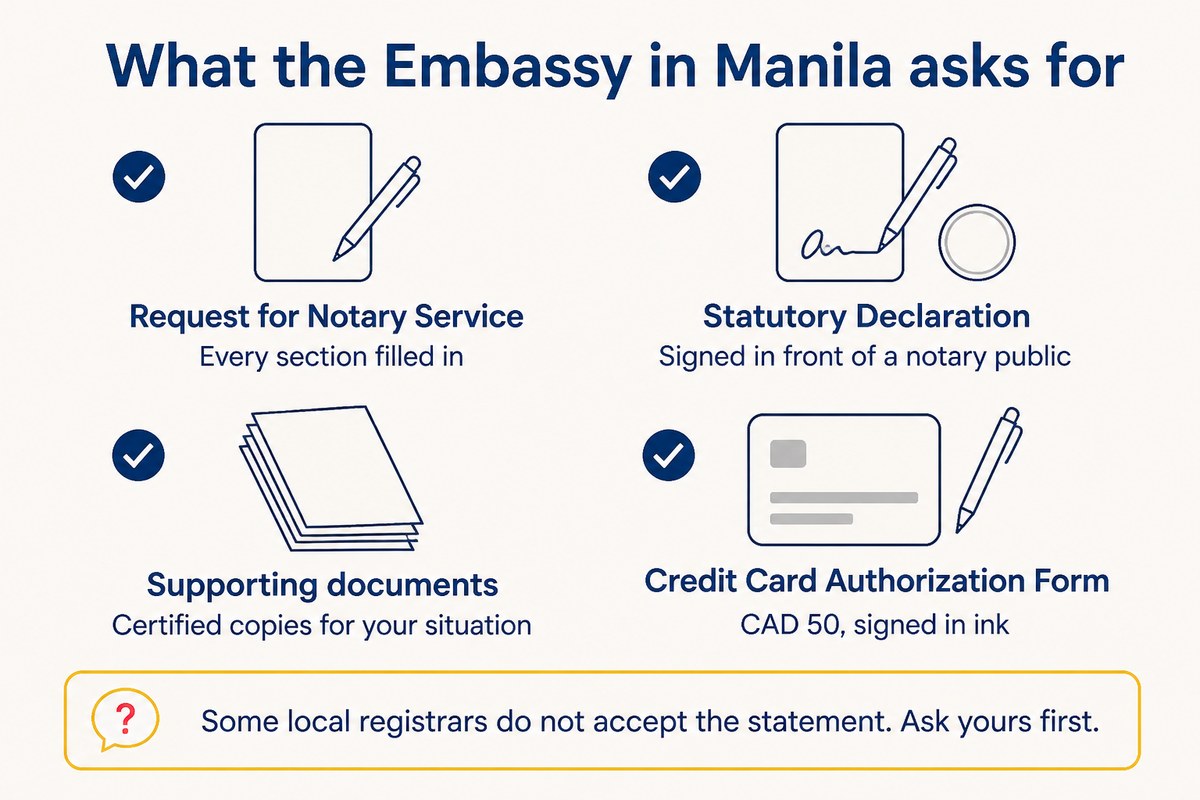
Canada does not issue that certificate. The Embassy in Manila prepares a Statement in lieu of certificate of non-impediment to marriage abroad instead, for CAD 50, and some local registrars do not accept it. Ask yours first.
Why Canada issues a statement, not a certificate
The Government of Canada's services page for Manila explains it. Unlike the Philippines, Canada keeps no central statistical registry of marriages, so the Embassy does not certify that a Canadian is free to marry.
That rules out a certificate of non-impediment, a certificate of legal capacity and a certificate of singleness or no marriage. What the Embassy offers is the statement, which is built on a sworn declaration you make yourself.
Hear about the next consular outreach mission
We’ll email you about upcoming consular outreach missions and new procedure guides. No ads, and you can unsubscribe at any time.
Who needs one
If you were born Filipino and reacquired the citizenship under RA 9225, ask the LCRO which document it expects from you before ordering anything.
What goes in the request
- The Request for Notary Service form, with every section filled in
- The Statutory Declaration form, signed in front of a notary public
- Supporting documents for your situation, as certified copies
- A Credit Card Authorization Form for the CAD 50 fee, signed in ink
On the request form, the Embassy asks you to answer “No” to items 3.1 and 3.2 in Section 3 and go on to Section 4. The form also needs a mailing address and a local phone number in the Philippines, because that is where the statement is sent.
The Statutory Declaration is bound to the statement. The Embassy accepts one notarized by a notary public from any country, so you can sign it in Canada before you fly.
The supporting documents
| Your situation | Certified copy to enclose |
|---|---|
| Born in Canada | Birth certificate or passport |
| Born abroad | Canadian citizenship certificate, permanent resident card or passport |
| Divorced | Divorce certificate |
| Widowed | Death certificate of your late spouse |
Every document has to be in English or French, or come with an official translation into one of them. The Embassy warns that Philippine authorities may not accept documents in French, and that they may ask for an official English translation of a divorce decree or a death certificate.
Fee, payment and how to submit
The fee is CAD 50, charged as a consular fee for specialized service. The Embassy takes it only by Visa or Mastercard through the authorization form, and only the original signed in ink: no scans. If you have no credit card, someone else can pay with theirs and sign the form.
You hand in the complete request in person, with an appointment booked online, or send it by commercial courier. The Consular Section is on Level 8, Tower 2, RCBC Plaza, 6819 Ayala Avenue, Makati City.
Applicants in the Visayas or Mindanao can hand in the full application in person at the Consulate of Canada in Cebu, after contacting it at [email protected].
How long it takes, and how long it lasts
The Embassy says it will tell you if the statement cannot be provided within 10 business days, not counting mail and delivery, and asks you to apply well before your travel dates. The statement goes to your Philippine address by courier, with delivery paid on arrival.
The statement has no printed expiry date, but a local civil registrar may refuse one issued more than six months before the wedding.So the timing has two ends: early enough to have it in hand when you file for the licence, and late enough to fall inside that six-month window.
If you were married before
The Embassy adds a warning for Canadians who were once married in the Philippines and divorced afterwards. A divorce decree may not be automatically recognized there.
The Embassy advises them to get legal advice or contact the Philippine Statistics Authority before remarrying, so that the new marriage is recognized as valid.
A widowed applicant encloses the certified death certificate, and the Philippine side may want it in English.
Frequently asked questions
Where can I get an LCCM as a Canadian?
Not as such. Canada does not issue one, and the Embassy in Manila prepares the statement that takes its place. Applicants in the Visayas and Mindanao can file through the Consulate in Cebu.
Can the Philippine consulate in Toronto issue it?
No. Toronto's page sends Canadians to the Canadian Embassy in Manila. The Toronto consulate page lists what that office does handle.
Do I need a visa to go and get married?
Not for a short stay. A Canadian passport holder can stay up to 30 days without one; our visa guide covers longer stays.
Do my Canadian documents need an apostille?
The Embassy's page asks only for certified copies with the request. Papers you later hand to Philippine offices are a different matter, covered in our apostille guide.