
NBI clearance from Canada

The NBI clearance is the Philippine police record that employers, immigration lawyers and Philippine agencies keep asking for, and the first thing to understand is that no consulate in Canada issues it. The National Bureau of Investigation prints it in Manila.
What the consulate does is small and specific: it notarises the fingerprint card that travels with your application, for CAD 38.75.
The consulate is one stop in this procedure, not the destination. Booking a consular appointment does not start an NBI application. The application itself is filed with the NBI in the Philippines, by courier or through a representative, and the clearance comes back from Manila.
What the clearance is and who asks for it
The NBI clearance certifies whether you have a criminal record in the Philippines. Canadian immigration asks for it when you apply for permanent residence and have lived in the Philippines for six months or more after turning 18.
Philippine employers, banks and licensing bodies ask for it too, and so do some adoption and annulment proceedings.
It is valid for one year from the date of issue, printed on the document. A clearance that expires mid-application usually has to be replaced, so time the request against the process that needs it.
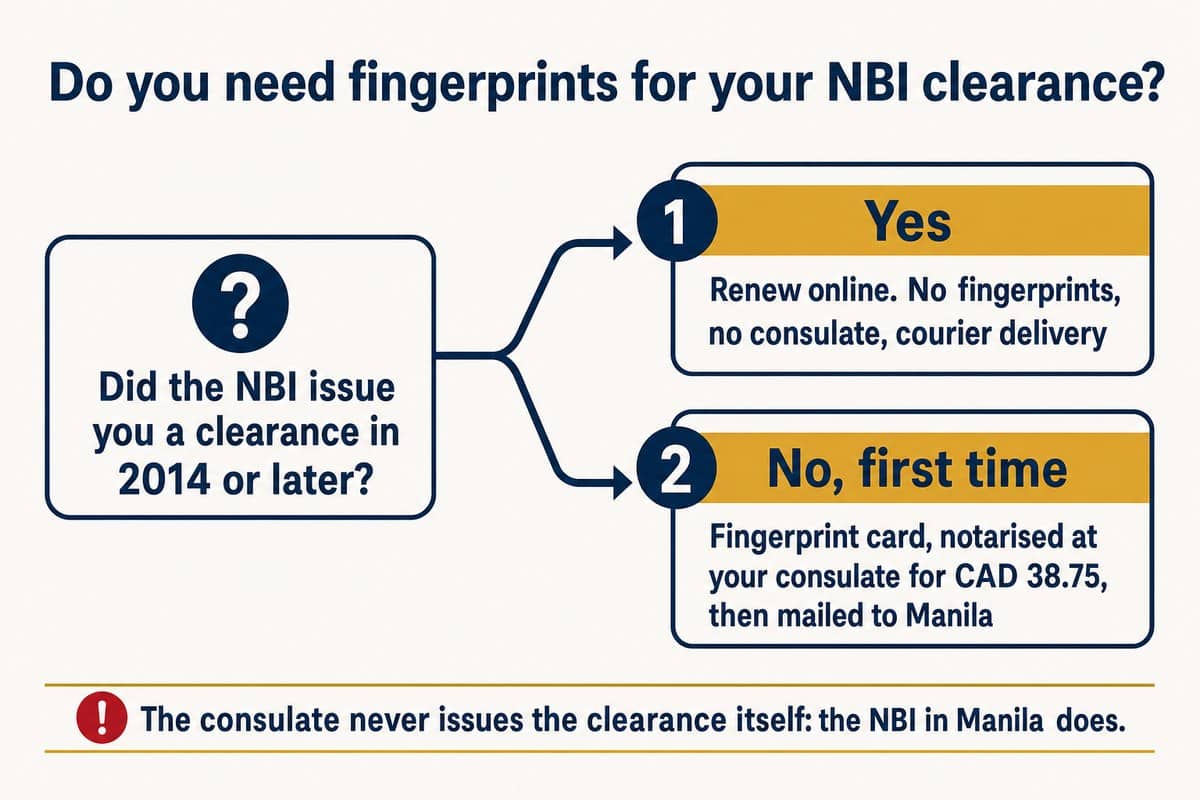
The two routes from Canada
Where the consulate comes in
The fingerprint card must be authenticated before the NBI accepts it, and that is the consular step. Personal appearance is required, because the officer certifies that the prints belong to the person in front of them.
Book at the post that covers your province: the notarisation fee is CAD 38.75 per document at the published schedule, payable by debit at the counter.
The card is a consular notarial act, so the same rules apply as for any affidavit: personal appearance and CAD 38.75 per document. If your immigration file also needs a PSA birth certificate, order it in the same week; both come from Manila.
The prints themselves are taken locally. An RCMP-accredited fingerprinting agency, a local police service that still rolls ink prints, or a private agency can do it. Bring the blank Form No. 5; the agency stamps and signs where it took the prints.
If your last NBI clearance was issued in 2014 or later, try the online renewal first. It skips the fingerprints, the notarisation and the consular appointment entirely.What to prepare
- NBI Form No. 5 (fingerprint card), fully accomplished
- Fingerprints rolled by a police service or accredited agency in Canada
- Valid Philippine or Canadian passport, plus photocopies
- Two recent 2×2 photos, white background
- Consular notarisation of the card, CAD 38.75, by appointment
- Courier arrangements or a representative in the Philippines with a signed authorisation letter
Timelines that are honest
Count the whole chain, not just the NBI's processing: getting prints taken in your city, a consular appointment that may be days or weeks out, courier time to Manila, NBI processing, and the trip back. Two to three months door to door is a realistic budget for a first-time application from Canada.
The online renewal, when it applies, runs on courier time alone.
One more time saver. If your record produces a "hit", a name similar to someone flagged in the NBI database, the clearance waits for manual verification in Manila and nothing filed from Canada speeds it up. Common Filipino surnames hit often. Build slack into any immigration deadline that depends on this document.