
The balikbayan privilege for Filipino-Canadians

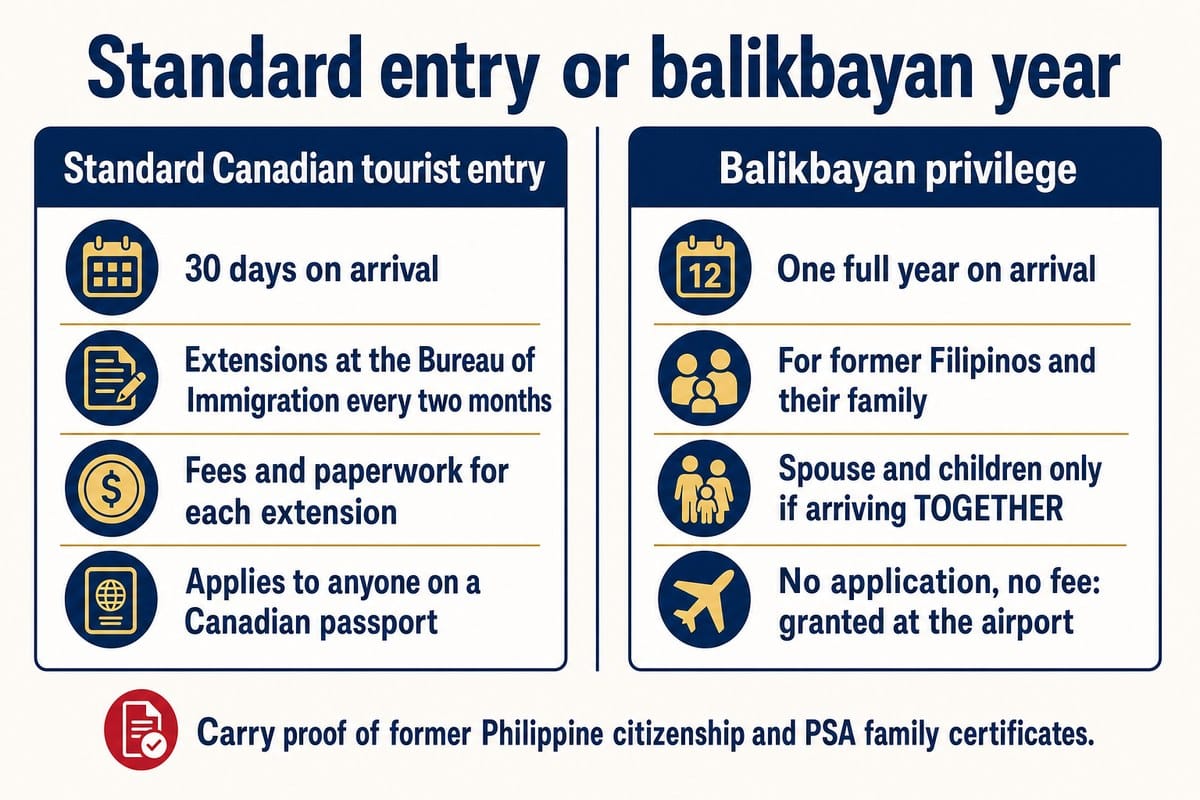
The balikbayan privilege is the best-kept open secret in Philippine travel: a former Filipino arriving on a Canadian passport can be admitted for one full year, visa-free, stamped at the airport. Not thirty days. A year.
And the privilege extends to the Canadian spouse and children, on one strict condition that catches families every month: they must be travelling together with the balikbayan.
“Together” means the same arrival. A Canadian husband landing in Manila three days before his Filipina wife gets the ordinary 30 days, not the year. The privilege attaches at immigration, at the moment the family presents itself with the balikbayan, and it cannot be claimed later or fixed retroactively.
Who counts as a balikbayan
What the year is worth
Compared with the standard 30-day entry, the balikbayan year removes the extension treadmill: no Bureau of Immigration visits every two months, no extension fees, no ACR I-Card for the first year.
For a family testing retirement in the Philippines, or a long care visit to ageing parents, it is the difference between a bureaucratic calendar and a free one.
| Entry route | Initial stay | Cost at entry |
|---|---|---|
| Standard Canadian tourist entry | 30 days | Free |
| Balikbayan privilege | 1 year | Free |
| 9(a) visa bought in Canada | Stamped on arrival | From CAD 46.50 |
The documents that make the stamp effortless
- The balikbayan’s proof of former Philippine citizenship: old Philippine passport, PSA birth certificate, or dual citizenship papers
- PSA marriage certificate for the spouse
- Birth certificates for the children
- Passports valid six months beyond the stay, for everyone
- Return or onward tickets; airlines ask even when immigration does not
When RA 9225 is the better answer
The balikbayan privilege is a stamp; citizenship is a status.
If the trips are becoming yearly, or property and inheritance have entered the conversation, reacquiring Philippine citizenship ends the counting altogether: a dual citizen enters on the Philippine passport and stays as long as they please, no privilege required.
The oath costs CAD 77.50 once; the balikbayan year costs nothing but expires. Families deep enough into the Philippines to be reading this section usually end up doing both, in that order.
One caution for the year itself: overstaying past the granted period puts the family into ordinary extension rules with fees backdated from day 366. Diarise the date; the stamp in the passport is the only reminder anyone issues.