
Consular notarials and the Special Power of Attorney

The consular notarial section is where Canada-based Filipinos sign the papers that act for them in the Philippines: the Special Power of Attorney that sells a lot in Batangas, the affidavit that fixes a name, the deed a bank in Manila insists must be "consularised".
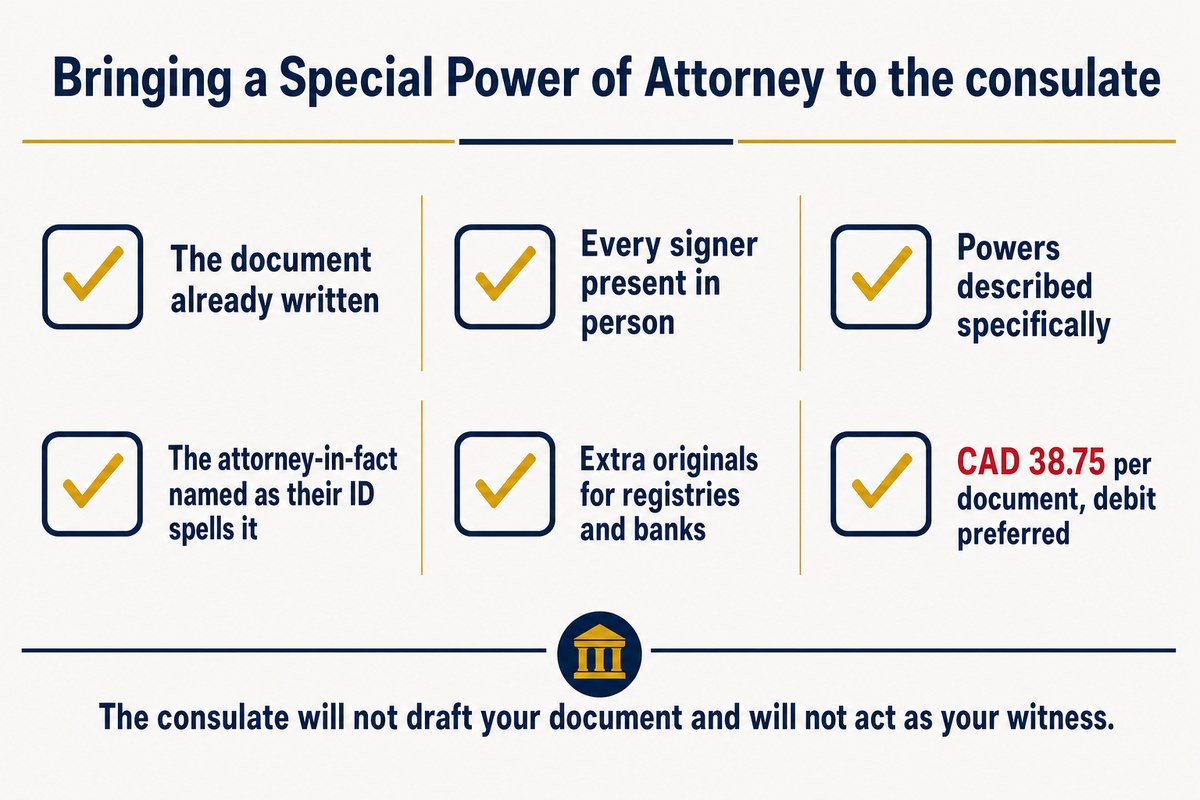
Every act costs CAD 38.75 per document, requires personal appearance, and comes with two refusals people rarely expect: the consulate will not draft your document, and it will not act as your witness.
Come with the document written and every signer present. The consul certifies signatures made in front of them. Blank forms, absent co-signers or documents already signed at home are the three reasons notarial appointments fail.
What the section actually does
| Act | What it is for |
|---|---|
| Acknowledgment | Deeds and powers: SPA, deeds of sale or donation, extrajudicial settlements |
| Jurat / affidavit | Sworn statements: loss, support, discrepancy of names, single status |
| Certification | True copies and certificates the post is authorised to issue |
| Oath of profession | Professionals taking oaths required by Philippine regulators |
The Special Power of Attorney, done right
The SPA is the workhorse: it lets someone in the Philippines sign for you. Three details decide whether it survives contact with a Philippine registry:
- The powers described specifically: “to sell the property covered by TCT No. …”, not “to transact all my business”
- Your attorney-in-fact named exactly as their Philippine ID spells them
- All signers appearing together at the consulate with valid passports or IDs
- Extra originals: registries keep one, banks keep one, and a spare costs another CAD 38.75 now versus a new appointment later
- Payment by debit; credit adds the 2.4% surcharge
Or skip the consulate: the 2024 alternative
Since Canada joined the Apostille Convention, the same SPA can be signed before a Canadian Notary Public and then apostilled by the provincial or federal competent authority. That route never touches a consulate, which matters if the nearest one is a flight away.
Two cautions: the receiving agency in the Philippines must accept apostilled foreign notarials, most now do, and in Alberta and Saskatchewan only a Notary Public qualifies, a Commissioner for Oaths does not.
Choose by geography. Within an hour of a consulate, the consular route is cheaper and lands in Philippine form directly. In Moncton or Yellowknife, notary plus apostille by mail beats a 2,000 km round trip every time.
The affidavits that unblock other procedures
Most affidavits signed at the posts exist to feed some other application: the affidavit of loss that accompanies a lost-passport replacement, the affidavit of discrepancy when documents spell a name two ways, the affidavit of support for a travelling relative.
If your affidavit is a step inside a bigger procedure, book both at once and say so; some posts handle the affidavit within the main appointment instead of making you queue twice.
Honorary consulates and notarials
Winnipeg, Halifax and Regina do not hold notarial commissions. The signature happens at a career post or during an outreach mission, where notarial services usually travel with the team; outreach transactions add CAD 15.50 per document to the schedule.