
Apostille for Canadian documents used in the Philippines
On 11 January 2024 Canada joined the Apostille Convention, and the oldest consular procedure in the book died quietly: Philippine consulates in Canada no longer authenticate Canadian public documents that carry an apostille.
If a Philippine agency asked you for a "red ribbon" or consular authentication of your Canadian diploma, RCMP check or birth certificate, the answer changed, and most advice pages on the internet have not caught up.
The consulate does not issue apostilles. Calgary says it in bold on its own site. Apostilles on Canadian documents come from Canadian competent authorities, and once the apostille is attached, the document is accepted in the Philippines with no consular step at all.
Who issues the apostille in Canada
| Document issued in / by | Competent authority |
|---|---|
| Federal bodies (RCMP checks, federal corporations, IRCC letters) | Global Affairs Canada, Ottawa |
| Ontario | Official Documents Services, Toronto |
| Quebec | Ministère de la Justice du Québec |
| British Columbia | BC authentication programme |
| Alberta | Ministry of Justice, official documents office in Edmonton |
| Saskatchewan | Ministry of Justice and Attorney General, Authentication Services |
| Other provinces and territories | Global Affairs Canada |
The rule of thumb: the government that issued or notarised the document apostilles it. An Alberta degree goes to Edmonton, an RCMP certificate to Global Affairs Canada, an Ontario birth certificate to Toronto.
Private documents need a notary first
Contracts, authorisation letters, company papers: a competent authority only apostilles what a recognised public officer has signed, so private documents get notarised first and the apostille certifies the notary.
One Calgary warning worth repeating verbatim in spirit: only a Notary Public qualifies, not a Commissioner for Oaths. In Alberta and Saskatchewan the two are different offices, and a commissioner's stamp will bounce at the apostille counter.
Going the other direction? Philippine documents used in Canada are apostilled by the DFA in the Philippines, not by any consulate here. The Philippines has been in the convention since 2019.What is left for the consulate
Two things survive at the consular counter, at CAD 38.75 per document:
Choosing between the two routes
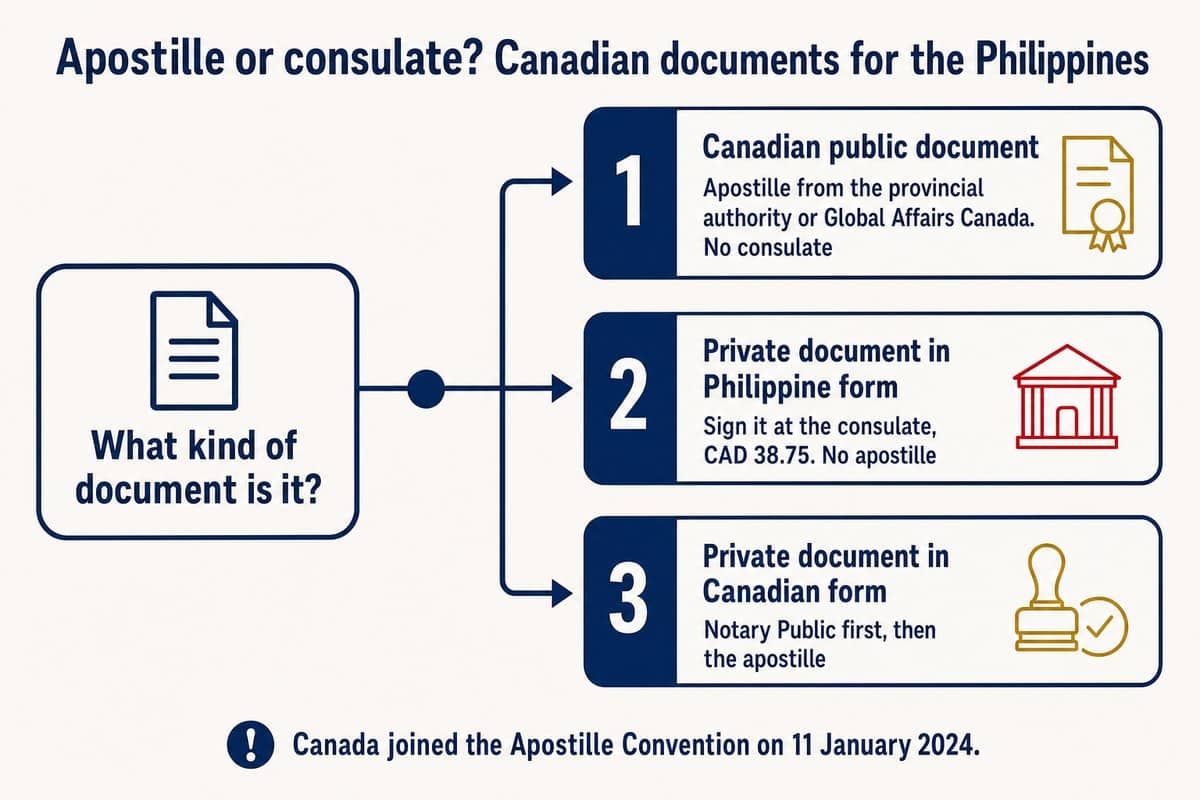
- Canadian public document for use in the Philippines: apostille from the Canadian competent authority. No consulate involved.
- Private document that must be in Philippine notarial form: sign it at the consulate, CAD 38.75, no apostille needed.
- Private document in Canadian form: Notary Public, then the provincial or federal apostille.
- Philippine document for use in Canada: DFA apostille in the Philippines, ordered through relatives or agencies there.
Timelines favour the consular route when it applies: an apostille by mail from a provincial authority runs days to weeks, while a consular acknowledgment happens in one appointment. Price the courier legs before choosing.